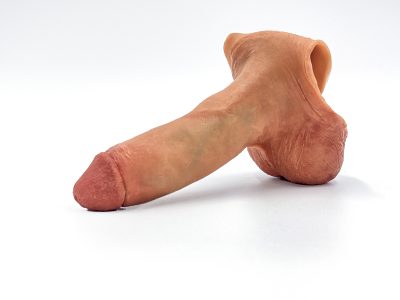
The right packer size is the one that gives your body balanced, natural proportions: it depends on your build, your height and your frame, not on a single number. The right skin tone is the one that matches your own skin up close, in daylight. This guide explains how to choose both, with the real measurements of our three models and the way we match every prosthesis to your skin.
Will it look too big?
This is the first worry almost everyone has. Many people write to us asking how many models there are and which one is best, and behind the question there is often the same fear: a bulge that looks too obvious.
The answer is proportion. A packer that suits a tall, broad person can look too large on a slim, shorter frame, and a small packer can look lost on a bigger body. What you want is a shape that looks like it belongs to you, in jeans, in joggers and in swimwear.
There are no fixed rules. When we help someone choose, we start from anatomical and statistical data about average proportions, then add common sense. After that, the person comes first: how you feel, what you want to see, how you live.
What decides the right size?
Several things play a part, and they weigh differently for each person.
- Height: the taller you are, the more length and girth look natural on you.
- Frame and weight: a broader or heavier build balances a larger size; a slim build usually looks more natural with a medium one.
- Clothes: tight jeans, swimwear and sports shorts show more of the shape than loose trousers.
- Dysphoria and passing: some people need a clearly visible shape to feel right; others prefer something discreet.
- Lifestyle: sport, long days on your feet or a physical job may make a slightly smaller, lighter size more comfortable.
- Personality: some people simply want a bolder look, others a quieter one.
Preferences also change. Some people start with a larger size and, over the years, move to a smaller one. There is nothing wrong with that: your first packer does not have to be your last.
FTMS packer sizes compared
We make three models. Each one comes in a set girth and a length range, and you choose the exact length within that range when you order.
| Model | Size | Girth | Length range | Who it usually suits |
|---|---|---|---|---|
| Goliath | Medium | 12 cm (4.7″) | 12-16 cm (4.7″-6.3″) | A natural everyday size, the easiest to wear under any clothes |
| Achilles | Large | 13 cm (5.1″) | 14-18 cm (5.5″-7.1″) | A fuller look with a wider girth |
| Hector | Extra large | 14 cm (5.5″) | 18-22 cm (7.1″-8.7″) | The largest size, for a generous look and bigger builds |
Girth is the measurement around the shaft. Length is measured along the shaft. The ranges overlap on purpose: a 15 cm Goliath and a 15 cm Achilles have the same length but a different girth, so the Achilles looks fuller.
Every model comes in two versions, the filled 3in1 and the hollow 4in1 Multiuse with stand to pee (STP). Size and version are two separate choices: first the size, then the version. If you are not sure which version you need, our guide to what an FTM packer is explains the difference.
How to check a size at home
Numbers on a screen are hard to imagine. A few simple checks help you picture them before you order.
1. Use a soft tape measure. Wrap it around an object of similar thickness to feel what 12, 13 or 14 cm of girth means in your hand. 2. Mark the length. Measure the length you are considering on a ruler and hold it against your body, over your underwear, standing in front of a mirror. 3. Look at yourself in the clothes you wear most. The right size is the one that looks natural in your everyday jeans or trousers, not the one that looks impressive on its own. 4. Think about sitting and moving. A longer packer moves more when you sit, bend or run. If you are active, consider the shorter end of a range. 5. If you already own a packer, measure it. Knowing what feels too small or too large today is the most useful information you can give us.
How to choose the length within a range
Once you have picked the model, choosing the length is a fine adjustment.
- Choose the shorter end of the range if you want something discreet, wear tight clothes or do a lot of sport.
- Choose the middle of the range if you are unsure. It is the most balanced option for most builds.
- Choose the longer end if you are tall, have a larger frame or want a more visible shape.
If you are unsure between two sizes, write to us on WhatsApp before ordering. Tell us your height, your build and what you want the packer to look like, and we will help you choose.
What if none of the sizes fits?
Some people want a slightly different girth, or a few more centimeters of length. We can make a piece to your own measurements, even starting from a photo.
Making a custom piece or lengthening an existing model takes almost the same work, because a new master (the model the moulds are made from) has to be created. For that reason we prefer to make unique pieces, which are also more satisfying for us as makers. The cost of customisation is the price of the Custom anatomical change option, and a custom piece takes two to four weeks.
Why skin tone matters
A packer that does not match your skin never looks real, however detailed it is. Mass-produced packers usually come in a handful of shades, so an exact match is rare, and colours on a screen are often different from the product you receive.
Every FTMS prosthesis is painted by hand to match your skin. The colour is not chosen from a list: it is built for you, from a photo of your arm.
How to take the photo for your skin tone
The photo is what we work from, so it is worth taking it carefully. You need three things:
- Natural daylight: near a window during the day, without direct sun on your skin and without lamps on. Artificial light changes colours a lot.
- A white A4 sheet of paper next to your arm. The white sheet lets us see how the light and your camera shift the colours, and correct for it.
- Both sides of your arm: the inner side and the outer side. They are usually two different shades, and both help us read your skin.
A few more tips:
- Turn off filters, beauty modes and automatic colour effects on your phone.
- Take the photo from a normal distance, with the arm and the sheet both in focus.
- Avoid tanned areas or skin covered by lotion or make-up, if you can.
How we match and confirm your colour
The colour goes through two checks before the prosthesis leaves the workshop.
1. The colour code. From your photo we pick your colour as a hex code (the code that describes a colour precisely on a screen) and send it to you to confirm. 2. The finished piece. Before shipping, we show you the finished, hand-painted prosthesis.
Thanks to these two checks, very few people are unhappy with the colour. If something does not look right to you at either step, tell us: that is exactly what the checks are for.
Common mistakes when choosing size and colour
- Choosing the biggest size by default. Larger is not more realistic. A size that is out of proportion with your body is easier to notice.
- Deciding from a photo of the product alone. Size depends on your body, so picture it on you, in your clothes.
- Sending a photo taken under a lamp. Warm or cold artificial light changes the colour we see. Daylight and the white sheet make the difference.
- Forgetting the version. Size and version are separate choices. Choose the size for your body, then the 3in1 or the 4in1 for what you want to do with it.
- Not asking. If you are unsure, a short message before ordering saves time for everyone.
Once you have your packer, good care keeps the colour and the surface as they are for years: see our guide on how to clean a silicone packer. For a broader look at prostheses, read what an FTM prosthetic is. When you are ready, compare the three models on our FTM packers page.
Frequently asked questions
What size packer should I get?
Choose the size that gives your body natural proportions, based on your height, frame and weight. Goliath is medium, Achilles is large and Hector is extra large, and you choose the exact length within each range when you order.
Does my height decide the size?
Height matters, but it is not the only factor. Frame, weight, the clothes you wear, your lifestyle and how visible you want the shape to be all play a part.
What do girth and length mean?
Girth is the measurement around the shaft; length is measured along the shaft. Our girths are 12, 13 and 14 cm, and the lengths range from 12 to 22 cm across the three models.
How do you match the packer to my skin tone?
We work from a photo of your arm, taken in daylight next to a white A4 sheet, inner and outer side. We send you the colour as a hex code to confirm, then show you the finished, painted prosthesis before shipping.
Can I change size later?
Yes, many people do. Some start with a larger size and choose a smaller one later. Your preferences can change with time, and that is normal.
Can you make a packer to my own measurements?
Yes. We can make a custom girth or length, even from a photo. The cost is the price of the Custom anatomical change option, and it takes two to four weeks.