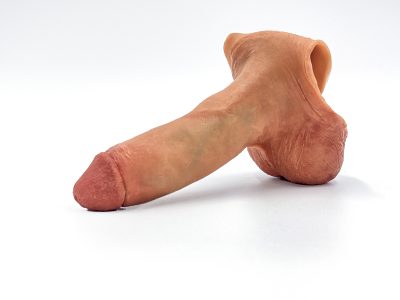
To clean a silicone packer, rinse it with lukewarm water after each use, use a mild soap when it needs more than water, and let it dry completely before you store it. Never use alcohol-based products or silicone-based lubricants, and never scrub it. With this simple routine, a medical-grade platinum silicone packer can last five to six years.
Why care matters for a silicone packer
Silicone is one of the easiest materials to keep clean. Medical-grade platinum silicone is non-porous: dirt and moisture stay on the surface instead of soaking in, so water and a gentle wash are usually enough. Cheaper materials like TPE and TPR are porous, absorb dirt and become sticky with time.
Easy does not mean careless, though. A packer is worn close to your skin for many hours, sometimes in heat or during sport, and an STP packer also has liquid passing through it. Good habits protect two things at once: your skin and the prosthesis.
On a hand-painted prosthesis like ours, care also protects the colour and the fine details of the surface, such as the movable skin and the veins. The two things that harm them most are the wrong products and scrubbing too hard, and both are easy to avoid.
How to clean a silicone packer, step by step
This is the routine we recommend for everyday use.
1. Rinse it with lukewarm water as soon as you take it off. Water alone removes most sweat and residue. 2. Use a mild soap when needed: a small amount of gentle, unscented soap, spread with your fingers. A cleaner made for silicone prosthetics is also fine, as long as it contains no alcohol. 3. Wash gently. Use your fingertips, not brushes or rough sponges. Pay attention to folds and to the base, where sweat collects. 4. Rinse well. Soap residue can irritate your skin the next time you wear the packer. 5. Pat it dry with a soft, clean towel that does not leave lint. Do not rub. 6. Let it air dry completely before you store it or put it back on.
That is all an everyday clean needs. You do not have to disinfect a silicone packer with strong products after each use.
What to avoid: products that damage silicone
Some common products ruin silicone, often for good. Many people do not know this until it is too late.
| Avoid | Why | Use instead |
|---|---|---|
| Alcohol and alcohol-based disinfectants or wipes | They damage silicone and can harm the hand-painted colour | Water, mild soap, an alcohol-free cleaner |
| Silicone-based lubricants | Silicone on silicone damages the surface | Water-based products only |
| Condoms lubricated with silicone lubricant | Same problem, often overlooked | Check the label for the type of lubricant |
| Brushes, rough sponges, abrasive cloths | Scrubbing wears the surface and the paint | Fingertips and a soft towel |
| Bleach, solvents, harsh household cleaners | Too aggressive for silicone and for your skin | Mild, unscented soap |
| Dishwasher, boiling or very hot water | Heat and detergents are not needed and can stress a painted surface | Lukewarm water |
If you are not sure about a product, do not use it on the packer. Ask us first.
How to clean an STP packer
An STP (stand to pee) packer needs a little more attention than a filled one, because liquid passes through the cup and the channel. At FTMS the STP packer is the hollow 4in1 Multiuse.
- After each use, rinse the cup and channel with lukewarm water. Let the water run through the channel from the cup to the tip.
- Once a day, or whenever it needs it, wash the cup and channel with a little mild soap, then rinse thoroughly so no soap stays inside.
- Never push rough objects into the channel. Water flowing through is enough; brushes can scratch the inside.
- Dry the channel completely. Hold the packer with the tip down so that the last drops drain, then let it air dry. Moisture left inside is what you most want to avoid.
- Clean the removable rod separately, with water and mild soap, and make sure both the rod and the hollow inside are dry before you put it back.
People often ask whether peeing through an STP packer damages it, or fills it with bacteria. Urine does not damage medical-grade silicone. What matters for hygiene is rinsing it after use and letting it dry well, so nothing is left sitting inside. The separate external STP device that comes with every 4in1 follows the same rules. For practical tips on using an STP, see our STP packer guide.
How to dry and store it
Drying is the step most people rush, and it is the one that keeps a packer fresh.
- Let it air dry on a clean surface, away from direct sunlight and heat sources such as radiators.
- Store it only when it is completely dry, inside and out.
- Keep it in a clean, dry and cool place, such as a breathable fabric bag or a clean box.
- Store it where it is not pressed or bent, so it keeps its shape.
- Keep it away from dust and lint, which stick easily to silicone.
Wearing it every day: your skin
A clean packer is only half of good hygiene. The skin under it needs care too, especially if you wear a packer for many hours.
- Wash the area every day with water and a mild soap, and dry it well.
- Wear clean underwear and keep your harness or pouch clean. A harness that fits well also reduces rubbing.
- Give your skin a break. Taking the packer off for some hours, for example at night, lets the skin breathe.
- Watch for friction. Redness where the packer rubs is often a sign that it moves too much or that the harness is too tight.
Platinum silicone takes on your body heat instead of heating up, and in general it does not make you sweat. Still, on hot days or after sport, rinse the packer and wash your skin a little more often.
If you use medical adhesive, remove it gently, following the instructions of the product, and wash the skin afterwards. We recommend a harness rather than adhesive, partly because a packer that must be washed often is much easier to manage when it is not glued to your skin.
When to talk to a doctor
This guide gives general hygiene information. It is not medical advice and does not replace a health professional. Stop wearing the packer and talk to a doctor if you notice:
- a rash, itching, burning or broken skin that does not go away after a few days without the packer;
- pain, swelling or signs of infection in the area;
- pain or burning when you pee, fever, or other signs of a urinary infection, especially if you use an STP;
- any reaction that you think may be an allergy.
If you know you are allergic to silicone, a silicone packer is not for you. We advise against buying our prostheses if you or your partner are allergic to silicone, even with a condom, because some parts are not covered by a condom.
What if a seam opens or the surface gets damaged?
Silicone is durable, but it is not unbreakable. Sometimes a seam opens or a small cut appears, for example where the rod goes in.
- Stop using the part that is damaged, especially if it is the STP channel, because liquid can get trapped inside an opening.
- Do not try to repair it with household glue or sealants. Most are not made for silicone that touches your skin.
- Write to us with a photo of the damage, and we will tell you what can be done.
We repair our prostheses. We replace the damaged parts, and the repair costs €50, which covers glue and silicone, plus shipping, which you pay. We never ask for more, unless the whole prosthesis has to be replaced: then the cost is about €150, quoted case by case.
How long does a silicone packer last?
It depends on how you treat it. A medical-grade platinum silicone prosthesis that is washed with water, kept away from alcohol and silicone lubricants and never scrubbed can last five to six years.
| Habit | Effect on lifespan |
|---|---|
| Rinsing with water after each use | Keeps the surface clean without wear |
| Drying completely before storing | Prevents moisture in folds and in the STP channel |
| Using alcohol or silicone lubricants | Damages the silicone, often for good |
| Scrubbing or using rough cloths | Wears the surface and the hand-painted colour |
| Storing it pressed or near heat | Can deform it over time |
For more about materials and types, read our guide to what an FTM packer is, or compare our models on the FTM packers page.
Frequently asked questions
How often should I clean my packer?
Rinse it with water after each use, and wash it with a little mild soap whenever it needs more than water. An STP packer should be rinsed after every time you pee with it.
Can I use alcohol or disinfectant wipes?
No. Alcohol-based products damage silicone and can ruin the hand-painted colour. Use water, mild soap or an alcohol-free cleaner made for silicone.
Which lubricant is safe with a silicone packer?
Only water-based products. Silicone-based lubricants, and condoms lubricated with silicone lubricant, damage the surface.
Can I boil my silicone packer or put it in the dishwasher?
We do not recommend it. Lukewarm water and mild soap are enough to keep it clean, and heat and detergents can stress a hand-painted surface.
Does peeing with an STP packer damage it?
No, urine does not damage medical-grade silicone. Rinse the cup and channel after use and let them dry completely, so nothing stays inside.
Can I swim with my packer?
Yes. Wear it with a harness that holds it firmly, then rinse it with clean water and mild soap to remove chlorine or salt, and let it dry completely before storing it.